The Myth of the Desireless Dom
By Aidan Sunassee · August 19, 2026 · 9 min read · Reflections
What Doms Crave and Why They Don’t Say It.
Photo by Drew Beamer on Unsplash
There is a fun little lie that follows Dominants around.
It dresses itself well. It has good posture. It knows how to speak in low tones and stand in doorways as if the lighting was personally hired for it. The lie says that Dominants do not need very much. That the person holding power must be fed by the holding itself. That command, once given, is its own nourishment. That if obedience is offered, something in us must be satisfied, neatly, cleanly, without residue.
Which is a lovely idea, if one happens to be writing erotica about a marble statue.
For the rest of us, with our unfortunately human bodies and irritatingly persistent nervous systems, the matter is a little less elegant.
Once you notice the silence around Dominant desire, it becomes difficult to unhear. You hear it in the way Doms can describe, with absurd precision, what their submissive needs to feel safe, cherished, corrected, praised, or pushed just far enough that the edge glimmers without cutting through the whole evening. They notice the breath, the posture, the hesitation, the tiny moment where something changes, and adjust before anyone else notices.
Ask a Dom what their submissive needs, and you may get a full answer. Possibly with examples. With sources and footnotes, if they are insufferable enough. (I say this lovingly.)
Ask that same Dom what they need, and suddenly, they have developed a deep and meaningful relationship with the corner of the room.
Most writing in D/s education begins with the submissive. What submissives crave. How to access subspace. How to be taken apart and put back together with a snack, a blanket, and a forehead kiss. This is important, of course. I’m not about to argue against making submissives feel seen. I do have a brand to maintain, but I’m not a monster. Submissives deserve language for their needs.
Still, there is an imbalance.
Dominants crave being wanted too.
Not only obeyed. Not only trusted to take the lead and keep everyone intact. Wanted. Chosen. Recognized as a person inside the authority, without the authority immediately vanishing because we have committed the apparently scandalous act of having feelings underneath the gaze.
This does not mean Doms who struggle to verbalize desire are secretly desperate for applause after every successfully delivered order (though, honestly, a little applause has harmed no civilization I am aware of). More often, they lack the words because dominance is so often confused with self-sufficiency.
Many of us have been trained by gender roles, trauma, family systems, stereotypes, or the sheer convenience of other people needing us to be fine, to treat need as something vaguely embarrassing. Something to be managed privately, folded neatly, and placed in the drawer marked "later," where many things go to die.
The result is a strange kind of eroticized loneliness.
A Dom can be obeyed and still feel unseen. They can be called a title, and still wonder whether their partner wants them or only wants the feeling of being under someone.
Now, I will not pretend that a well-timed “Yes, Master” does not occasionally improve the moral condition of the (my) universe. There is a reason many of us respond to the sight of a partner kneeling. I will not deny the near-orgasmic impact of a devoted s-type—obedience can be gorgeous. Still, if that very obedience becomes detached from desire, it can leave an ache behind.
A submissive may obey because the rule says so, or because protocol has become familiar enough to follow almost without thought. Beautiful. Well-trained. 10/10, would recommend.
Many Doms crave obedience that is not only correct, but eager. A submissive who does not simply kneel because they were told to, but because something in them wants to be at your feet. Your voice. Your hands. Your timing. Your mind. A great deal of Dominant desire lives in the wish to be wanted as the specific person holding power, not merely as a function.
But how is one supposed to say that without feeling unbearably exposed? What does a Dom do with a question like, “Do you want me or a fantasy of control”? It leaves you bare. It does not have the perceived dignity of “I need clearer communication after scenes.” Ultimately, it sounds needy in a way many Doms have spent years learning to avoid. After all, Doms are usually the ones reassuring the submissives, right? Right?!
They plan the scene, read the body, track consent cues, hold their own arousal on a leash so it does not outrun their judgment, remember the blanket, the water, the softer voice after the harder one, and somehow still locate the snack the submissive swore they did not need and will absolutely need in eight minutes.
Then, after all of that, after holding, grounding, praising, checking, cooing, loving, they whisper, "Did you enjoy that?"
Here is the secret, though it should not really be a secret at all.
A lot of Doms are starving for feedback.
Dominance is relational. A Dom needs to know what their authority does to the person receiving it. So, tell them.
- “I keep thinking about the way you looked at me when you gave that order.”
- “That made me feel owned in exactly the way I needed.”
- “I felt so safe with you.”
For Doms who are used to being pillars, praise can land with almost indecent force. People lean on them, build around them, idealize them, and then act startled when stone has memory. Taken off guard, they may laugh and nod with the solemn awkwardness of a teenage boy playing tough.
Praise them anyway.
In whatever way works for them, praise them.
Another inconvenient truth is that many Dominants are useful people. Useful in the way of crisis competence, quick decisions, and the ability to track fifty different things (for someone else, that is). Some of us learned to be useful because it was praised, or required, or because being needed felt safer than being wanted, since need at least comes with a job description. (Feel called out? Me too. Anyway.)
While feeling useful in the dynamic is not inherently burdensome, it becomes harder when usefulness is the only way the Dom feels wanted. When appreciation only arrives in response to discipline, steadiness, direction, or decisions, a question can start to form underneath it all:
Would I still matter if life got to me? If I could not hold everything the way I usually do? On the days I tire, what do I do?
That question can haunt for years, especially for Doms shaped by masculine socialization, caregiving histories, trauma, neurodivergence, chronic responsibility, or marginalization. It can sit beneath the surface of even the strongest dynamic, asking whether the person is loved or merely relied upon.
Of course, a submissive cannot and should not become the Dom’s emotional caretaker by default. We are not simply swapping one imbalance for another. But care can move in both directions, and sometimes the answer begins very simply.
- “How can I support you?”
- “I’m grateful for the effort you put into leading me.”
- “I want to understand what care looks like for you, too.”
And Doms, regrettably, we have our part too. If you are reading this with the deeply irritating sensation of being perceived, hello. I am sorry. I did not enjoy writing it either.
You can speak up.
- “I like being praised after scenes.”
- “I need reassurance after intense play.”
- “I need us to make space for my capacity too.”
Dominance is sustained by reciprocity, recognition, desire, trust, and the mutuality underneath even the most asymmetrical dynamics. It thrives when the submissive does not only look up at the title, but at the human being holding it.
Sometimes, what the Dom craves most is not worship, surrender, obedience, or even praise, though I remain firmly in favor of all four.
Sometimes what they crave is simpler, and therefore much harder to ask for.
To be looked at by the person kneeling before them and hear, in whatever language fits the relationship:
“I see you too.”
___
This article was written as a part of Obedience App's Obedient Season. If you want to download the full thing, do take a look. There's some fantastic stuff there.
Also, if you would like 20% off your Obedience App subscription, here is my affiliate link. That means you get a discount, and I get a commission. Great arrangement, if you ask me.
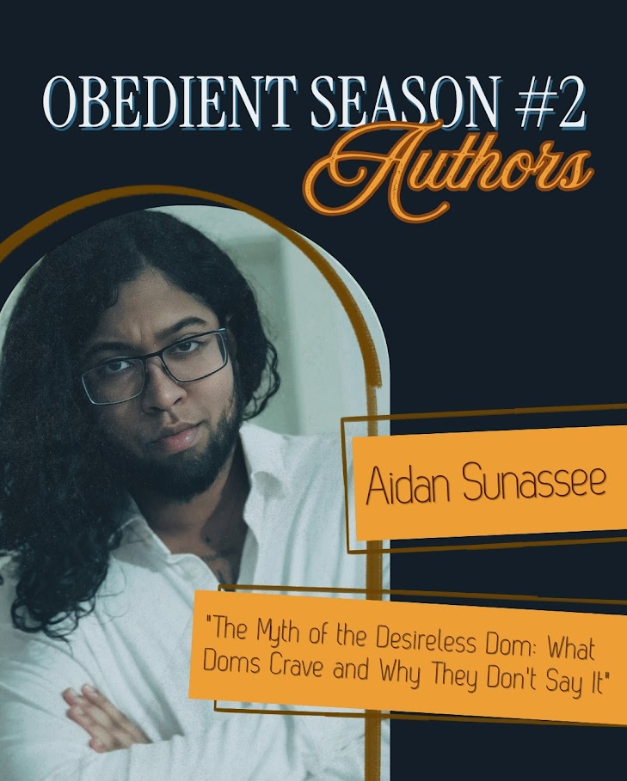
This is also my attempt at seeing if I can add in a picture in here, given I have been tinkering around with my website.
Woah, I can add a picture! I did it! Fantastic. Goodbye.
- dominant
- communication
- obedience app
More articles
Purging Media - A One-Week Check-In
Reflections · October 7, 2026
I had Charlie strip out all his media use. Yes, all of it. Videos, shows, audiobooks, music... Okay, there are some exceptions, as you'll see below, but the good majority of it is gone. A lot has changed recently, and I'm sure we'll catch you all up in a future article, but this has been one of the biggest changes in our dynamic. Read up if you're curious about his experience facing his thoughts with no distractions...
A Submissive’s Review of “Pillion” - A Gay BDSM Movie
Reflections · July 17, 2026
Pillion. We've got a lot of opinions on Ray, yes, but what does a submissive think about him? How does a submissive interpret the movie's plot? Well, lucky me (and you, by extension), I've got one who can talk about it. So without further adue, I present Charlie's review of Pillion. Which I posted late. Again.
Charlie’s New Year Reflection (In April)
Reflections · April 27, 2026
A long (and late) end-of-year reflection by Charlie. This was written on time, but it took me much too long to upload it. That is entirely on me, but better late than never, hm? Here, Charlie reflects on his submission, his move to Europe, giving up bodily control, the highs and lows, moments of cozy comfort, and absolute insanity that 2025 brought us. So... Happy New Year?
A Look Inside A Submissive’s Notebook
Reflections · April 27, 2026
In this article, Charlie describes a new addition to protocol: a notebook! When both Dom and sub are eternally busy, finding ways to connect to the dynamic even when we're both stuck to our desks for hours at a time becomes increasingly important. One of the ways we've found quite helpful is using a notebook in which plans, goals, and little notes can be exchanged back and forth, helping us track progress throughout the day and assign (and keep track of!) tasks more efficiently.
2025: A Dominant's Reflection
Reflections · December 31, 2025
A reflection on the past year. On growth, unfinished edges, and the responsibility of being trusted. Big shoes to fill, and yet I know they are my own. I'll meet myself again next year and we'll find our way there.
Why I Cannot Call Dominance a Choice: A Reflection on Kink and Identity
Reflections · September 12, 2025
This piece is a reflection on how I came to understand my dominance as more than a sexual preference, a hobby, or a role, but as part of who I am. It traces the pull toward structure, responsibility, and chosen order that has always shaped how I connect and love.
Written for the kink community by Aidan Sunassee and Charlie S.